


Luxury vinyl tile is one of the most widely specified resilient floors in offices, retail, hospitality, education and housing. It is also one of the most loosely described. The same two words can cover a thin glue-down tile for a corridor and a thick rigid-core plank for a living room, and the performance gap between them is large.
Key takeaways
- “LVT” is a marketing label, not a standard. Specify by wear layer, standard and use class instead.
- Wear layer thickness predicts durability better than total thickness does.
- Most field failures trace back to the subfloor (moisture, flatness, contamination), not the tile.
- Halead’s dry back LVT is offered in 2.0, 2.5 and 3.0 mm, glue-down; confirm wear layer and test data in the technical documents before ordering.
What “luxury vinyl tile” actually means
Industry commentary points out that LVT is a marketing term rather than a formal product category. Under ASTM F1700, products sold as LVT generally fall into Class III, printed film vinyl tile, though some residential “LVT” is built differently and performs differently (Spartan Surfaces). The rigid-core versions, which many buyers also call LVT or LVP, are covered by a separate standard, ASTM F3261, whose definitions again describe the LVT name as a marketing term.
The practical lesson: a product name tells you little. A purchasing document should name the construction (dry back or rigid core), the wear layer, the governing standard and the intended use class.
The wear layer: the number that matters most
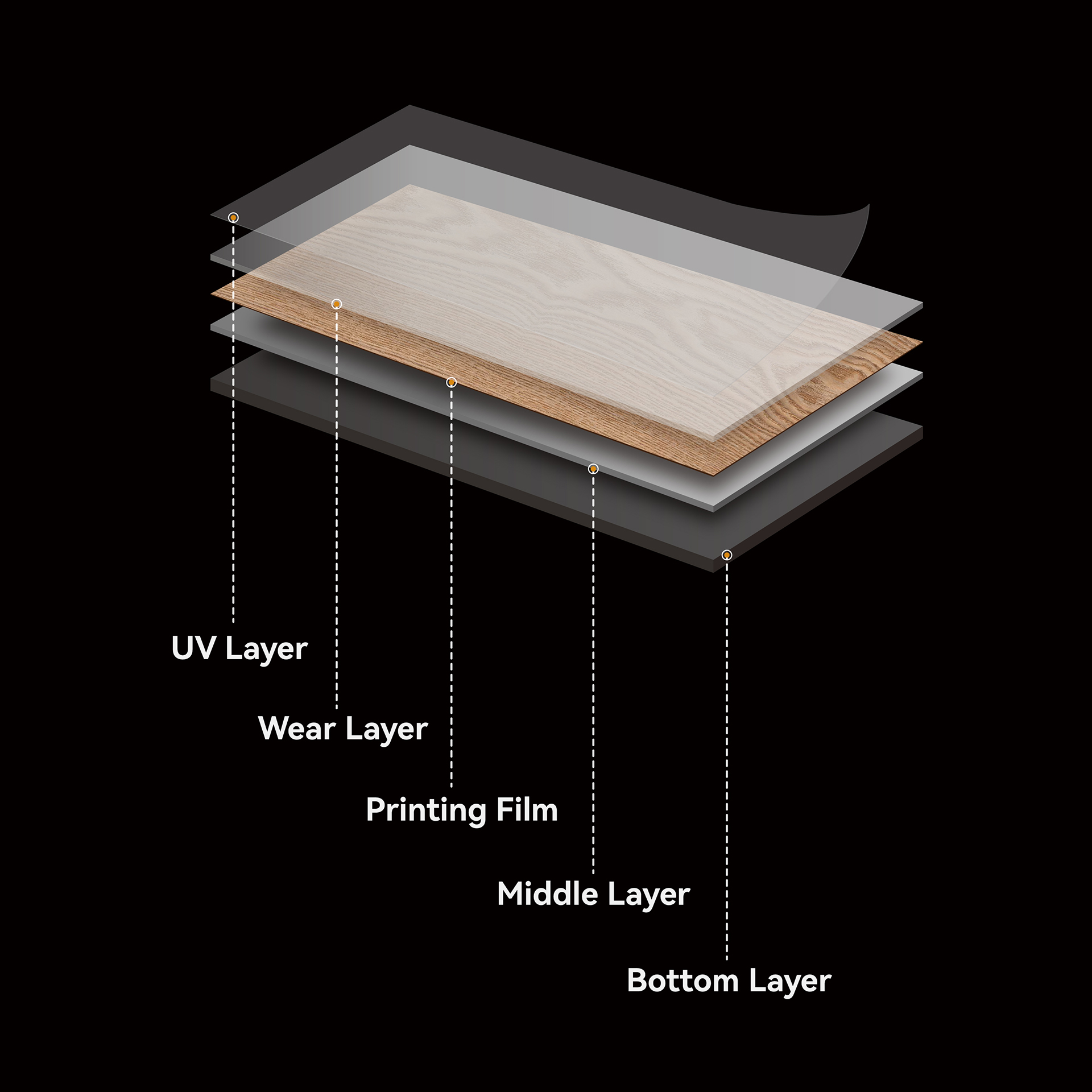
The wear layer is the clear film above the printed decor. It takes the abrasion, scuffing and traffic. ASTM F1700 sets a minimum of 0.020 in (0.5 mm), commonly called 20 mil, for commercial applications, and the same source notes that wear layers of 6, 8 or 12 mil suit light residential traffic (Spartan Surfaces). Manufacturers’ data sheets typically report it as tested to ASTM F410, for example in this published LVT specification page.
Total thickness is a weaker signal. A 5 mm tile with a thin wear layer will wear out before a 2.5 mm tile with a thicker one. Thickness does matter for other reasons: comfort underfoot, how well the tile masks small substrate imperfections, and acoustic behavior.
One transparency point for buyers: Halead’s LVT page lists thickness (without underlayer), finish, installation method and embossing, but it does not state a wear layer figure in the text. Check the downloadable LVT specification (PDF) and the Technical resources page, which also lists a Declaration of Performance for LVT, and request the wear layer in writing for your project.
Halead’s LVT range at a glance
Halead describes its luxury dry back vinyl as a balance of durability and realistic appearance for both commercial and residential areas. The table summarizes the vinyl products closest to LVT, using the figures published on each product page.
| Product | Thickness (without underlayer) | Installation | Notable features |
|---|---|---|---|
| LVT (dry back) | 2.0 / 2.5 / 3.0 mm | Glue | Matte or normal finish; wood, stone and EIR embossing |
| Design LVT | 2.0–5.0 mm | Glue | Special shapes: triangle, hexagon, oblique square, prism; suited to LVT and loose lay |
| Loose lay | 5.0 mm | Edges laid tight; anti-slip backing | No expansion gaps required; perimeter adhesive may be needed on larger installations |
| SPC flooring | 3.2–6.0 mm | Click | Rigid core aimed at dimensional stability |
Available tile and plank sizes are shown as an image on the product pages; confirm them with Halead before ordering.
Choosing between dry back, loose lay and rigid core
Dry back, glue-down LVT is the thin, dense option. It is a common choice where a low profile helps with door clearances and transitions, and where a bonded floor is wanted for rolling loads. The trade-off is that the adhesive bond depends entirely on a well-prepared subfloor, and a thin tile will tend to show underlying flaws. In practice that means flatness checks and patching are part of the job, not an optional extra.
Loose lay shifts the risk. Halead states its loose lay product uses an anti-slip backing and needs no expansion gaps, which can shorten installation and simplify later replacement. It is worth planning perimeter adhesive for larger areas, as the manufacturer notes.
SPC (rigid core) trades some thinness for stiffness. Halead’s SPC page calls it an upgraded version of click-lock LVT with a rigid core and strong dimensional stability, which suits renovations over imperfect substrates where a floating floor is acceptable.
Design LVT is where tile geometry becomes part of the design. Triangles, hexagons and prisms let a floor define zones, wayfinding or a feature area without changing material. Browse patterns in the decor library, which can be filtered by wood species (oak, walnut, maple), concrete, marble, terrazzo, travertine and slate, and by matte or high-gloss finish. A single example, HS2112012L, is a matte terrazzo pattern with a 1000 x 1580 mm pattern size.
Where installations usually fail: the subfloor
Resilient floors are largely impermeable, so moisture rising from a slab has nowhere to go. Industry guidance describes the results as adhesive breakdown, bubbling, cupping, gaps and mold, and notes that standardized tests exist precisely to prevent this (The Construction Specifier). The two common tests measure different things: ASTM F1869 (calcium chloride) reflects moisture emission at the slab surface, while ASTM F2170 uses in-situ probes to read relative humidity deeper in the concrete.
A flooring maker’s guidance describes probe testing with three holes for the first 1,000 sq ft and one more for each additional 1,000 sq ft, and treats a moisture test as essential over any concrete subfloor (Karndean). Acceptable readings depend on the adhesive, so take limits from the adhesive manufacturer rather than from a generic number. Slab preparation should follow ASTM F710, and surface pH matters too. One manufacturer’s residential guide, for instance, asks installers to test alkalinity and to acclimate flooring and adhesive for at least 48 hours before installation (Shaw installation guidelines).
Matching the floor to the traffic: use classes
ISO 10874 classifies resilient, textile and laminate floor coverings by area and intensity of use, so a specifier can say “class 33” instead of “heavy commercial” (ISO 10874). Domestic classes run 21 to 23, commercial classes 31 to 34 and light industrial classes up to 43; a 2020 amendment removed the former class 22+ (Amendment 1). The standard is also flagged as under revision, so check the current edition when writing a specification.
| Reference | What it covers | Why it matters |
|---|---|---|
| ASTM F1700 | Solid vinyl tile; Class III is printed film | Sets the commercial wear layer minimum of 0.5 mm |
| ASTM F410 | Wear layer thickness measurement | Lets you verify the mil claim on the data sheet |
| ASTM F3261 | Resilient flooring with a polymeric rigid core | Relevant to SPC-type products |
| ISO 10874 | Use classes 21–23, 31–34, 41–43 | Ties the product to expected traffic |
| ASTM F2170 / F1869 | Slab relative humidity (probes) / moisture vapor emission (calcium chloride) | Prevents the most common cause of bond failure |
| ASTM F710 | Preparing concrete floors for resilient flooring | Flatness, cleanliness and surface readiness |
Edition years change; always confirm the current version of each standard.
Indoor air quality and documentation
For schools, offices and healthcare, emissions documentation is often a bid requirement. FloorScore is the best-known certificate for resilient flooring; certificates reference the CDPH/EHLB Standard Method v1.2-2017 and are issued by SCS Global Services, which its own certificates describe as the only certification body approved by the Resilient Floor Covering Institute for the program (example certificate). Halead’s product pages do not state a FloorScore listing, so if your project requires one, ask for current certificate numbers for the exact product, and verify them in the certifier’s product guide. Halead’s ESG page describes pollution control, energy efficiency, product lifecycle management and recycling mechanisms as company commitments.
What factory quality control should look like
Consistency between batches is the quiet differentiator in tile. Halead’s quality control page describes a chain that starts with 100% virgin raw materials tested by batch, continues through in-process checks across more than ten production stages, and ends with finished-product inspection of surface flatness, color uniformity, texture clarity, abrasion resistance and slip resistance. A laboratory handles gloss, wear and scratch resistance, bending resistance and peel strength, and pallets are customized to the customer’s size and quantity to limit transit damage. These are the company’s own statements; ask for test reports on the specific decor and thickness you plan to buy.
A specifier’s checklist
- Name the construction (dry back, loose lay or rigid core) and the governing ASTM standard.
- State the minimum wear layer in mil or mm, and the ISO 10874 class for the space.
- Require moisture test results (F2170 or F1869), pH and a flatness check before installation.
- Acclimate flooring and adhesive for the period the manufacturer specifies, and use the recommended adhesive.
- Request the technical sheet, Declaration of Performance and any emissions certificates in writing.
- Approve a physical sample and, for large projects, reserve one production batch.
Frequently asked questions
Is thicker LVT always better?
No. Durability against wear is driven mostly by the wear layer. Thickness affects comfort, sound and how well imperfections are hidden, so choose it for those reasons.
Can LVT go in commercial spaces?
Yes, provided it meets the commercial wear layer minimum and the use class for the area. Halead positions its dry back vinyl for both commercial and residential use; confirm the project-specific data in the specification sheet.
Do I need a moisture test for a new slab?
Yes. Testing applies to concrete regardless of age, and new slabs can release moisture for weeks or months as they cure.


